

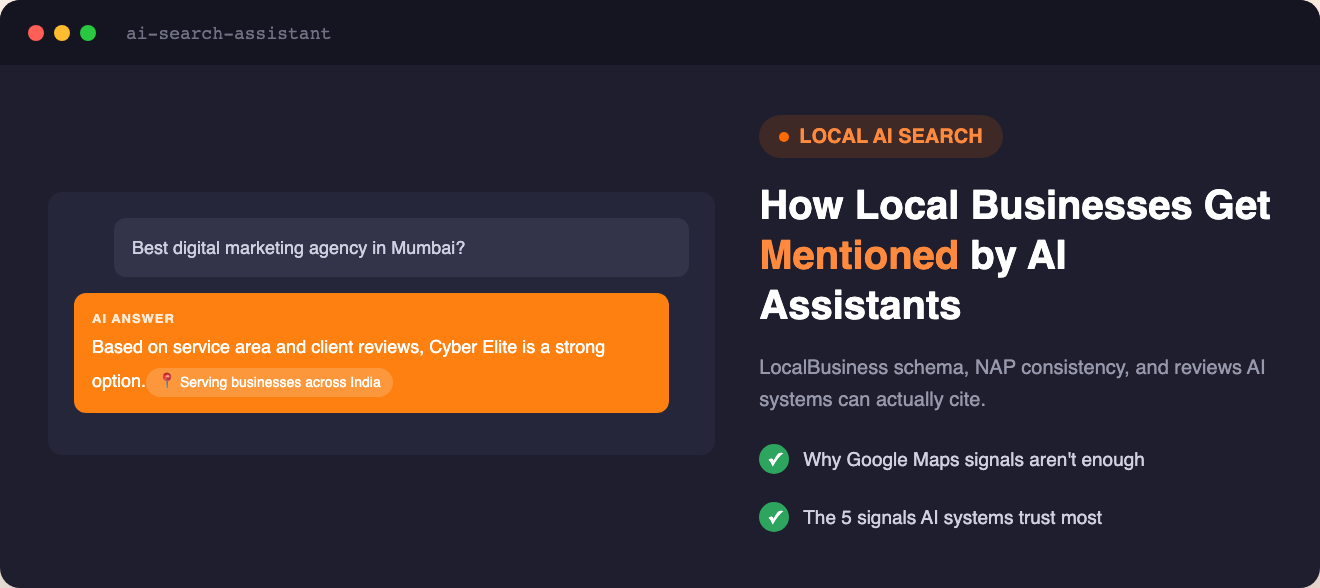
When someone in Mumbai or Bangalore asks ChatGPT “which digital marketing agency should I hire” or “best sales trainer near me,” the answer that comes back was built from somewhere. Local SEO has spent a decade optimising for Google Maps and the local 3-pack. AI search visibility for local businesses is a different, newer problem, and most local businesses in India have done nothing about it yet.
This is a practical look at what actually gets a local business mentioned when someone asks an AI assistant a location-specific question, and what to do about it.
Why Local AI Search Is a Different Problem Than Local SEO
Google Maps and the local 3-pack work off a fairly narrow set of signals: your Google Business Profile, review volume and rating, proximity to the searcher, and NAP (name, address, phone) consistency across directories. It’s a ranking problem with a known scoring system.
AI assistants like ChatGPT, Perplexity, and Google’s AI Overviews don’t rank a list of pins on a map. They generate an answer, and they pull the businesses they mention from whatever content gives them enough confidence to name a specific company for a specific question. A business can have a perfect Google Business Profile and still never get mentioned in an AI answer, because the AI isn’t reading your GBP listing. It’s reading your website, and whatever else is written about you elsewhere on the web.
What Signals AI Systems Actually Use for Local Answers
LocalBusiness schema
This is the most direct signal available. LocalBusiness schema markup states your service area, address, hours, and business category in a structured format an AI system can parse without ambiguity, instead of trying to infer it from a paragraph of marketing copy. A page that says “we serve Mumbai and the surrounding region” in prose is giving an AI system something to guess at. The same page with LocalBusiness schema is giving it something to read directly.
Location-specific content, not just a location-specific title tag
Plenty of sites have “Digital Marketing Agency in Mumbai” in a title tag and then generic, could-be-anywhere content underneath it. AI systems weigh genuine location-specific detail, like which industries you serve in that city, how long you’ve operated there, and what local market conditions you understand, more heavily than a location keyword dropped into a headline once.
Consistent NAP across the sources AI systems actually crawl
Name, address, and phone consistency still matters for AI search, for the same reason it matters for traditional local SEO: contradictory information across your website, directory listings, and social profiles lowers confidence in any single answer. AI systems are more cautious than Google’s local algorithm about naming a specific business when the underlying facts don’t line up cleanly.
Reviews and third-party mentions, read as content, not just as a star rating
Google’s local algorithm treats reviews largely as a numeric signal: rating and volume. AI systems can actually read the text of reviews and third-party write-ups. A review that says “they handled our Google Ads for our Bangalore showroom and cut our cost per lead in half” is far more useful to an AI system building an answer than a bare five-star rating, because it contains the specific claim an AI system can cite.
Topical depth across your site, not just your homepage
An AI system judging whether to recommend a “digital marketing agency in Chennai” is more confident recommending one whose site demonstrates real expertise across SEO, PPC, and web development than one whose only Chennai-related content is a single thin location page. Breadcrumb schema and clear internal linking between your service pages and location pages help make that site structure legible to an AI crawler.
What to Actually Do About It
Add LocalBusiness schema to every location and contact page
If you serve multiple cities, each location-specific page should carry its own LocalBusiness schema reflecting that specific service area, not one generic block copy-pasted site-wide. Most SEO plugins, including Rank Math and Yoast, generate this through form fields without requiring you to write JSON-LD by hand.
Write location content that says something a competitor’s page doesn’t
Replace generic “we serve X city” language with specifics: which local industries you’ve actually worked with, how long you’ve had a presence there, and what makes serving that market different from serving a different one. This is the same content-depth argument that applies to AI citation generally, applied specifically to location pages.
Audit NAP consistency across your website, Google Business Profile, and any directories you’re listed in
A quick manual check across your site footer, contact page, Google Business Profile, and any major directory listings catches most inconsistencies. Even small mismatches, like a suite number present in one place and missing in another, are worth fixing.
Encourage reviews that describe specific outcomes, not just star ratings
You can’t script what a customer writes, but you can ask satisfied clients to mention what you actually did for them rather than leaving a generic rating. A review with a concrete result is more useful to both human readers deciding whether to hire you and AI systems deciding whether to mention you.
Link your location pages to your service pages, and vice versa
If your Mumbai page and your SEO services page never link to each other, you’re making an AI system work harder to understand that you offer SEO services in Mumbai specifically. Direct internal links, plus BreadcrumbList schema, close that gap.
FAQs: AI Search Visibility for Local Businesses
Is AI search visibility for local businesses different from ranking in Google Maps?
Yes. Google Maps ranking runs on a relatively narrow set of signals: your Google Business Profile, reviews, and proximity. AI systems generate an answer from your website content and any third-party mentions of your business, so strong Google Maps rankings don’t automatically translate into being mentioned in an AI answer.
Do I need a separate page for every city I serve?
For any city that’s a meaningful part of your business, yes, a dedicated page with genuine local detail and its own LocalBusiness schema performs better than a single generic page trying to cover multiple cities at once.
Will better Google reviews help with AI search too?
Reviews that describe specific outcomes help more than a high star rating alone, since AI systems can read and cite the actual text of a review in a way they can’t cite a number.
How long does it take to see results from these changes?
There’s no fixed timeline, since it depends on how often AI systems and search crawlers revisit your site and how much genuinely new, specific content you’ve added. Treat it as a foundational fix rather than something with an immediate payoff.
Can I do this myself, or do I need an agency?
The schema and NAP-consistency work is mechanical enough for most businesses to handle directly, especially with a plugin like Rank Math. Writing genuinely differentiated location content, and structuring internal links well across a larger site, is where most businesses benefit from outside help.
Where This Leaves You
The businesses that show up when someone asks an AI assistant for a recommendation aren’t necessarily the ones with the best product. They’re the ones that have made it easy for an AI system to verify who they are, where they operate, and what they’ve actually done. LocalBusiness schema, honest location-specific content, and consistent facts across the web are the mechanical parts of that. None of it is complicated, and most local businesses in India haven’t done any of it yet, which is exactly why it’s worth doing now rather than later.
If you want a straightforward audit of how your business currently shows up (or doesn’t) in AI search answers, our team at Cyber Elite can walk through it with you.


